
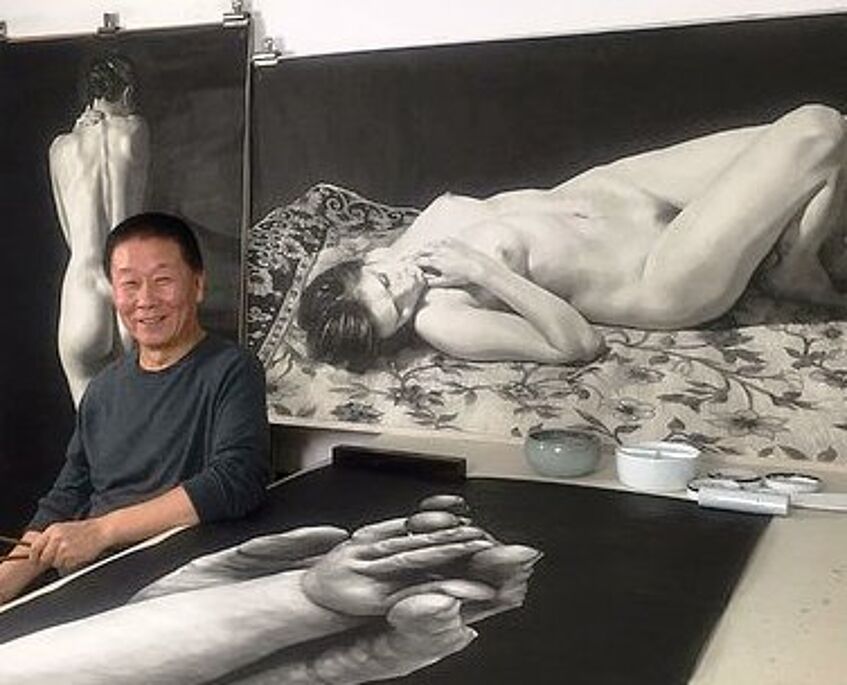
Qu Leilei

Qu Leilei
Qu Leilei
... was born in Heilongjiang (Northeast China) in 1951, his father Qu Bo was a well-known writer, who had worked with the communist troops in Northeast China. In 1955 his familiy moved to Beijing. Qu Leilei was eight years old when he began to learn traditional Chinese calligraphy and painting. Later he became interested also in Western art. Between 1977 and 1978 he studied anatomy at the Beijing Medical College. In 1979 he founded - together with Ma Desheng, Huang Rui, Zhoung Acheng and others the "Stars" Artists' Association and participated in their exhibitions. Qu also contributed illustrations to the Independent Journal "Today". Between 1982 and 1985 he worked as a graphical designer for the Central Chinese TV. In 1985 Qu Leilei moved to London to continue studying arts and become an independent painter. He participated in numerous of exhibitions in England, France, Venice, New York and other places. Today Qu Leilei lives with his family in London's Wimbledon district.
Interview with Qu Leilei (in July 2014 in his home in London/Wimbledon)
Here you find the Chinese text of the interview.
Interviewer (Helmut Opletal): First of all, I'd like to ask you, what are your thoughts when you look back on the period of 1979 and 1980 more than 30 years later?
Qu Leilei: Time flies. Looking back now, first, this was a very important period of history, one in which individual lives were intertwined with the overall situation in China, because China was facing an enormous transformation at that time. From the end of the Cultural Revolution till today, during this past half-century, China has undergone earth-shattering changes.
Simply put, from Qin Shi Huang to Mao Zedong, many things have remained very much the same. Of course, dynasties have changed many times, but they have all circulated within a framework, from dictatorship to violent revolution, and then to a new dictatorships triggering again violent revolutions - a cycle like this. This is determined by the characteristics of China's historical development, and these characteristics are formed by China's culture and ways of thinking, which are difficult to change through individual consciousness.
Confucianism, Taoism, and Buddhism have marked China for two thousand years. Why do I say this? Simply put, Confucianism fit perfectly for the rulers; it was a culture for training and ruling slaves.
Every revolution in China aimed to overthrow Confucian culture, but once power was gained, it was discovered that only Confucianism could govern China. Second, many intellectuals were not incorporated into the system. Hooligans, bandits, and peasant uprisings did not seem a threat, but it was the intellectuals that the rulers were afraid of. So a way was needed for them. And when they did not pass the exams to become officials and enter the civil service, Taoist culture provided a way out, allowing them to write articles, find solace in nature, and paint.
Buddhist culture was set for ordinary people. It required them to accept their fate and then pray for the next life. So these three settings supported the overall framework of China that continued until the 20th century. At the beginning of the century, also many foreign beliefs came in, such as Christianity.
However, Mao Zedong used Marxism, because he thought it was useful, and he introduced Marxism and communism. When the three traditional systems that had supported China for more than two thousand years were no longer working, new things were needed. The new things strongly proposed at the beginning were Mr. Democracy and Mr. Science, as they were called. But they had no foundation in China, China was too backward. But Marxism and Leninism seemed very useful. They stood for violent revolution, the use of violence to overthrow the rich and give land and assets to the poor. This had some foundation in China.
So Mao was successful using them, and there were historical reasons for this. History keeps repeating itself, and this repetition reached its extreme during the Cultural Revolution. Mao Zedong's totalitarianism and dictatorship, with one person ruling everything and a billion people sharing a single mind, reached its extreme during the Cultural Revolution, leading China to the same extreme.
China was already on the verge of collapse then. Production had been down for ten years; we had nothing to eat, and over 40 million people had starved to death in the 1960s. But production was stopped even more during the Cultural Revolution. I am telling my daughter now that back then, we had to use ration coupons for everything, and each person was only entitled to quarter of a liter of oil and ten eggs a month…
Interviewer: Is your daughter listening to these stories?
Qu: Yes, she wants to hear them. My daughter said, "I really wish I had as much experience as you." But I replied, "No, I hope you never have to go through these things. I hope you're happy and can just live your life." But we had no choice. At that time, everyone knew that things couldn't go on like this, but as long as Mao was alive, nothing would change.
When Mao died in 1976, this meant the end of an era, or rather, the end of an entire political system. Everyone knew things had to change, but they didn't know how. Hua Guofeng [Mao’s designated successor] started very slow, insisting on the "Two Whatevers," meaning that whatever Mao Zedong had said couldn't be changed, whatever Mao’s policy decisions were, we would have to follow.
In the end, Deng Xiaoping didn’t want to wait any longer and criticized "Two Whatevers," saying that some things that Mao had said might even be wrong, so the "Two Whatevers" were not acceptable, and we rather had to test the truth through practice.
Deng Xiaoping used this to bring down Hua Guofeng. After Deng came to power, he was very clear about what he wanted to do. He was a remarkable and very important figure in Chinese history. Of course, he later made a major mistake, but that's another matter, when he mobilized the army to suppress the 1989 Tian’anmen Square protests. This was a huge mistake.
Deng Xiaoping played such a significant role because he followed a pragmatic philosophy, the "black cat, white cat" analogy. [In 1962, Deng quoted a saying: "Yellow cat, white cat. As long as it catches mice, it's a good cat." Later, the yellow cat became black cat, leading to Deng Xiaoping's "white cat, black cat theory."]
Everyone knew the importance of developing production. But how? Developing the economy required reform. And how to reform? Take the capitalist road. He couldn’t say so, because capitalism was bad and counter-revolutionary [laughs], he could only say “Socialism with Chinese Characteristics,” which was essentially capitalism with Chinese characteristics.
People think China's development in recent years was a Chinese creation, but that's not true. China's development was a comprehensive integration into the international financial, trade, and production system. China relied on its cheap labor, on imports and exports, and foreign investment. Then it mobilized its own inland market, and then used large-scale exports to capture the low-end markets of foreign countries. That's how it developed.
After Deng Xiaoping came to power, all sorts of ideas that had been suppressed during the Cultural Revolution, started to resurface. Mao was no longer there, and Hua Guofeng had also been ousted, but Deng's power was not yet consolidated. This period, from around 1977 to 1979, was very vibrant intellectually, with all sorts of ideas emerging.
One famous example was the Xidan Democracy Wall. I personally enjoyed art, but I was also interested in politics or literature, aspiring to become a politician or writer. But I enjoyed creating art, and tried to express my own life experiences, thoughts, and feelings through my art.
Interviewer: Where did your desire to pursue art come from? I heard your father was a well-known writer?
Qu: Yes, and this has formed me from a young age. At my mother's side of the family, they were all doctors. In my family, all the women were doctors, and all the men were writers like my father. My brother is a journalist, and I'm an artist.
Actually, drawing has been a hobby of mine since I was little; I started drawing before I could even write. Then my mother taught us to recite ancient Chinese poems. After we finished reciting, each of us would draw a picture based on the poem's meaning. According to Chinese culture, there is poetry in painting, and painting in poetry; poetry and painting are always combined. I've also written some poetry, but I don't think I'm a serious poet [laughs].
I was more interested in drawing. I started learning traditional Chinese painting from elementary school on, landscapes, figures, flowers and birds, and calligraphy. In the 50s and 60s, education had changed in China. Calligraphy and drawing became part of the art classes. Many children didn't like handling ink, but for me it couldn’t be enough. My family was very supportive because many of my father's friends were also painters, calligraphers, or writers.
Interviewer: Were they all traditional?
Qu: Yes. But I was also exposed a little to Western things, for example, to Russian or Italian art and literature, but very limited.
Interviewer: Did you have access to any such books at home?
Qu: There was a bit of literature at home, not much, but mostly literature. So I read a lot when I was little, like Shakespeare, Balzac, Dickens, and so on. I read these at a very young age, and I also got to view a little bit of Western art, sculpture and classical oil paintings from Russia. I was particularly attracted by nude art, because you know, during a boy's adolescence, it looks incredibly beautiful.
So there was some Western influence, but most influence still came from Chinese tradition. In school I received education in revolutionary heroism, but as far as music was concerned, there was a big gap. We knew nothing from jazz to the Beatles. Between Mozart and Rock’n Roll, there was a void in between.
Also Western modern literature, or Western modern painting didn’t exist, we didn’t know anything about it. It was like going straight from classics to, for example, from Michelangelo to Picasso. I knew very little about Picasso at that time, just a tiny bit, because Picasso was a communist [laughs], so I got to know a little. But we knew more about Käthe Kollwitz, because Lu Xun had specifically introduced her.
I've always been very interested in traditional painting and calligraphy since I was a child. Then the Cultural Revolution arrived in 1966. I was 15, a second-year junior high school student, and everything was in chaos. My parents and I became political targets and were persecuted.
I was still interested in painting, but I felt that I could no longer fully express my thoughts through traditional painting. So I started learning Western painting to express my inner thoughts more fully through Western techniques and concepts.
In 1968, I was sent to the countryside as part of the "educated youth" movement. I worked as a “barefoot doctor” and farmer. Farming was very hard work in the great northern wilderness of Heilongjiang province. Winters there reached minus forty degrees Celsius. But that time was very important for me, and I learned a lot.
My parents were "liberated" in 1969. They had been considered "capitalist roaders" in 1968, but in 1969, new policies were implemented, meaning some cadres were no longer judged as "capitalist roaders" and set free, but they continued to be sidelined. Others, like Deng Xiaoping, were liberated only to be overthrown again. My mother also experienced this several times. In short, I was no longer one of the "five black categories" [landlords, rich peasants, counter-revolutionaries, bad elements, and rightists,] but considered a “good” person again, and eligible to join the army.
So, in 1969, I became a soldier, serving in the 38th Army southwest of Beijing. I served for four years, during which time I still loved to paint, but I didn't have many opportunities to do so. Painters need to sketch from life. Where my unit was stationed, there were very beautiful mountains, shaped like wolf teeth, hence the name Wolf Tooth Mountain.
I had to paint secretly, for example, on the margins of newspapers. To paint publicly, one could only depict Chairman Mao, Red Guards, workers, peasants, and soldiers. When politicians fell in political disgrace, we had to ridicule them in caricatures, so when Liu Shaoqi was removed from power, we'd paint cartoons of Liu; the same for Deng Xiaoping [Laughter] and later Jiang Qing and the Gang of Four when they were overthrown…
Interviewer: So you did propaganda work in the military...
Qu: Sometimes there were occasions to paint, but I mainly wrote articles. Having served as a soldier, I was transferred to be an army reporter. I did a very good job, and just when I was about to be promoted to became a cadre, the Beijing Public Security Bureau sent a document to our unit, saying that I had opposed Jiang Qing [Mao’s wife in charge of culture] and the Central Cultural Revolution Group in middle school during the early stages of the Cultural Revolution.
This was actually true. Because at that time, we had formed some [Red Guard] factions and wrote big-character posters and other pamphlets opposing the ultra-leftist tendencies of the Central Cultural Revolution Group in 1967 and 1968. We especially opposed Jiang Qing's verbal attacks on armed defense forces, and thus instigating armed struggle, it said. In fact, Jiang Qing spoke very casually and rudely, so we criticized her, and that was reported now to our army unit.
When someone was arrested, I became implicated during his interrogation. Therefore, my promotion was halted. I continued to work and did a good job while I remained under investigation, for two years. But finally, they decided there were no problems. The army unit I was attached to happened to be my father's old unit. So the investigation ended, because someone had intervened.
After this investigation, I didn't want to continue in the army because that wasn't what I wanted to do. I requested to return to Beijing because Zhou Enlai had proposed the "Four Modernizations" at the National People's Congress [that was actually in 1975, but Zhou was already considered a pragmatist in the leadership earlier.]
Interviewer: In which year did you return to Beijing?
Qu: 1973. When the investigations against me started it was also the time of the Lin Biao incident [Mao’s declared successor fleeing persecution and killed in a plane crash.] 1971 was also an important personal turning point because several other things happened. I had a very good girlfriend, but she broke up with me because I was under investigation, which was a huge blow to me. My career, which had been on the rise, was also halted by the investigation, which dealt me another blow.
Because Lin Biao was the most senior superior of the army, I started to question what was happening in China all together. We had always deeply respected and admired Mao and Lin Biao, but now I started to make up my own thinking. Then Zhou Enlai proposed the "Four Modernizations," opening China up to the United States, and there was Nixon's visit to Beijing.
All these things happened between 1971 and 1972, a very important turning point. That’s when I decided that I would wait for the investigation to end, and after that, join the development of the Four Modernizations. I was very excited and convinced that China had to follow this path of modernization. So in 1973, when my investigation had ended, I requested to leave the army and return to Beijing.
I was assigned to work at Beijing Television. Initially, I did lighting and electrical work for TV documentaries. This gave me the opportunity to travel extensively throughout the country, visiting factories, rural areas, military units, or schools, allowing me to gain a deeper understanding of what was truly happening in China. These experiences outside Beijing made me think.
I also tried working with radio and related fields, but I had to realize that our generation had missed out on the most crucial stages of education, missing subjects like mathematics, physics, or chemistry. So this became difficult, when at the same time global science and technology were developing rapidly, and the United States had already landed on the moon.
When we watched documentaries, we simply couldn't believe the difference. When I was in the army and in the countryside, we felt so poor, and we barely had enough to eat or wear. After I started working in 1973, I just asked myself what I really wanted to do. Finally, I discovered that it was painting that I loved most. My parents were very supportive, saying, "Okay, then focus on painting, no matter what happens." From 1973 onwards, I began to paint seriously, devoting all my spare time to it, and began to systematically study Western painting.
One day in 1973, I visited a friend who was a musician. His father was the vice-dean of Peking University and the first cultural attaché to the Soviet Union, a very cultured man therefore. However, during the Cultural Revolution, his father was kept prisoner at Peking University and later became paralyzed because of his maltreatment. Only then he was allowed to return home, because the Red Guards were unwilling to care for him.
One day I visited him; he was lying in bed, looking very lost. There were books everywhere that hadn't been burned. Our own our house had been ransacked three times, because there were so many books. Back then, books were either burned or sent to paper mills to be pulped and used to print Mao Zedong's works published during the Cultural Revolution.
Back then, one of our greatest amusements was stealing books. When the library was closed, we'd steal books and pass them around. So I actually got to read a lot of books at that time. Many Western classics were read during the Cultural Revolution, because the more the authorities forbade them, the more we wanted to read them.
At his home, the former vice-dean told me there were some art books at the bottom of his shelf, and I could take a look if I was interested. Those art books were covered in a thick layer of dust, such as the 1932 Japanese publication “A Complete Collection of World Art.” That was the first time I saw Impressionist paintings, and I felt that my horizons broadened, when I realized for the first time that paintings could be like this.
Previously, my knowledge of oil paintings was limited to Russian artists like Ilya Repin, Vasily Surikov, or Isaak Levitan. But after seeing Monet, Degas, or Renoir, I suddenly realized that there could be another kind of art. However, at that time, I hardly understood Cézanne, Van Gogh, or Gauguin, only later friends explained to me that they were particularly important. But Monet and Degas I had understood immediately.
Back then, I rode a bicycle, and every day I'd take two “mantou” (steamed buns,) a piece of pickled vegetable, and a painting box with me, and went out to paint whenever I had time. I copied impressionist paintings and studied them, and also did a lot of sketching.
My mother was teaching at medical school, and she asked, "If you want to make painting your career, how can I help you?" I said, "The most important thing you may help me is to study human anatomy." She replied that would be convenient because she had a good relationship with the university professors, and she will talk to the physiology professor.
Just that time, there was a graduate program. As the Cultural Revolution wasn’t over yet, it was the first course, and they recruited so-called “worker-peasant-soldier students.” One of these classes prepared to study anatomy, and I was allowed to join them, so I learned human anatomy at medical school for about a year. I think this helped me immensely.
I knew from books, that figures like Leonardo da Vinci and Rembrandt both stole corpses to study anatomy. This is very important in art. So after that period of study, I felt I had a breakthrough, and no longer had any problems with human anatomy. In terms of color, I mainly studied the impressionists. Just as important was that I always tried to use art to express what was in my heart. But I hadn’t yet found my own artistic language or way. So I continued until 1976.
I just mentioned that 1971 was a major turning point, but 1976 was an even bigger one. The events of ‘76 brought together all of China's history, future, culture, and morality. The year began with the death of Zhou Enlai, followed by Zhu De, then the Tangshan earthquake, the death of Mao, the arrest of the Gang of Four, and the end of the Cultural Revolution. And I also suffered from encephalitis that year, a very serious illness.
So this was a very important year, a year of profound transformation. I was working at CCTV, making news documentaries. After the Tangshan earthquake, we went there to film the aftermaths and the disaster relief efforts. It was the deadliest earthquake in history. Official reports spoke of 200,000 deaths, but I think it was actually closer to 400,000 or 500,000. During daytime, we filmed the relief efforts and the restoration of production, because production had to go on. Yao Wenyuan, a member of the Cultural Revolution Group, said, "What's does an earthquake matter? It has erased a city from our map; but our most important task now is the revolution.”
When I had nothing to do at night, I pondered a lot in my tent, about the whole situation, what was happening in China, about the Cultural Revolution, our own family experiences, my family members and friends, and the many people we knew who had been forced into suicide or murdered… all these things went through my mind.
Whenever I had free time, I would use a small sketchbook and a pen, to sketch and sketch, line by line, drawing and drawing, like a flow of water. This way made me rejoice a bit then, because I felt like I had a language I could speak. For example, I drew a few lines to depict the wind. Above the wind, I drew an eye, and a person with flowing hair. But the reality was rather heavy. I wanted that kind of freedom, but it was just blowing my hair up. And the Earth was bleeding, the blood was flowing, and there was a troubled God. There was a girl, tears falling, flowing like a river, and a bloodstained sword, depicting insults, revenge, and so on.
I depicted a lot of this kind. Later, I gave many of those drawings away, or pasted them on the Democracy Wall. They'd be taken down at night, and then put back up during the day. [Laughs] Some of my line drawings were met with interest, and sometimes I heard people saying, "Oh, I know this person, he made line drawings back then." That's what I produced at that time. Later, some of these drawings were printed in the “Today” magazine, where contributed quite a few illustrations.
Interviewer: Let's go back to 1976...
Qu: I was still painting. When the Cultural Revolution ended in 1976, the Gang of Four was arrested, and people were full of joy, and in Beijing all the liquor was sold out. This excitement lasted until early 1977. People were celebrating, knowing that things were about to change, but not knowing how. Everyone hoped for a big change under Hua Guofeng's leadership. But when nothing changed, people became dissatisfied and started to talk.
I was still painting then. I also had some poet friends, and some who wrote novels and texts which later became known as "scar literature." These major works and ideas emerged around 1977 and 1978. Before 1976, we were all doing it privately, not too seriously or proactively, but secretly.
In ‘77 and ‘78, people started seriously writing, photographing, or painting. I made many friends. My best friends at the time included Guo Lusheng, whose pen name was Shizhi, a very famous poet. There was also Liu Huiyuan, who studied theory and history, and Xie Hong, who worked in film; also the quite famous Wang Lixiong, who later specialized in research on Tibet and Xinjiang. His pen name was Baomi, and he wrote a book called “Yellow Peril”, which became quite well-known.
We met regularly at Zizhuyuan Park where we planned to publish a magazine that should focus on poetry and literature. After meeting three or four times for discussions, Guo Lusheng – Shizhi, as we called him – mentioned that there was already a magazine with the same idea, called “Today”, so we didn't need to do something separate. Guo then introduced us to them, and we joined “Today”. I was with the magazine from the second issue anwards; the first was basically done by Bei Dao, Mang Ke, Huang Rui, and a few others.
I was glad to get to know them, since we all had similar ideas, and there was no need to do anything separately. I started participating in the debates for “Today”, then drawing many illustrations to be published in the magazine. Illustration for the inside front cover or back cover of “Today”, I would just draw by hand, because engraving on steel plates was too difficult. The issues also got posted on the Democracy Wall, including my drawings, but they were often taken down at night, just to be put up again the next day. This was repeated through several issues.
In 1978, when Huang Rui and Ma Desheng started preparing for an exhibition, they discussed it with everyone. I said, "Great, let's do an exhibition together!" We repeatedly applied to the China Artists Association, but it wasn't approved. Later, we talked to some more artists, and I suggested we invite a very good sculptor named Wang Keping. I introduced him to the group, including Mao Lizi and Yang Yiping, who were also good friends of mine from childhood and excellent painters.
So, about twenty people from different backgrounds came to participate in the exhibition, but it still wasn't approved. So we decided we couldn't wait any longer and needed to find a suitable date ourselves. In 1979, we had been preparing this exhibition for over half a year, and then we decided the best time would be around the 30th anniversary celebrations of the founding of the People’s Republic.
I was very enthusiastic and firmly said, "No matter what, we must go ahead with the exhibition." There were mainly five or six of us discussing it: Huang Rui, Ma Desheng, Wang Keping, Acheng, and myself. Sometimes Li Yongcun, Bo Yun, and Yan Li also participated. After long debates we came to the conclusion that if we couldn't exhibit inside the gallery, we would exhibit outdoors. Around National Day in the autumn seemed to be a suitable moment.
Interviewer: When you agreed on that, were you not afraid of consequences at all?
Qu: When we agreed, we thought we had the right to do so, therefore we weren’t afraid. I believed that there was nothing wrong with doing art. I didn't think the Democracy Movement was so terrible either, anyhow, it hadn’t been banned. Moreover, the Democracy Wall was very supportive of Deng Xiaoping, only Wei Jingsheng was an exception. Initially, the Democracy Wall people were against Hua Guofeng and supported Deng Xiaoping's rule, and they wanted reforms implemented as quickly as possible. Hadn’t Deng himself said that the Democracy Wall was “a good thing” and should be maintained? But in fact, once he had consolidated his power, he didn’t want it, saying it shouldn’t be allowed any more. [Laughter]
Interviewer: Did you perceive this matter very clearly at the time?
Qu: Well, I didn’t. We thought we were just doing art. We were against the Gang of Four and the Cultural Revolution. I had no problem with Deng Xiaoping. Only Wei Jingsheng went a bit further when he said we should "be wary of new dictators" and pursue the Fifth Modernization.
I thought he was quite radical and extreme at that time, but he had good ideas, for which I admired him. I had known him for a long time; we were playing and going to school together during the Cultural Revolution. He was already studying Marxism and the communist movement then, and he later continued doing so.
Interviewer: So you already knew him during the Cultural Revolution?
Qu: Not very well, but I knew him. When he was later arrested, the final charge against him was "selling intelligence information," but in fact these were things which everyone already knew. [Laughs]
Interviewer: So what was your opinion at the time?
Qu: I didn’t really know. Wei Jingsheng was a very talented person, and a righteous person. One could agree with his views or disagree. It was hard to say who was right, who was wrong. It could be debated, but what he did, was not a political action, just a viewpoint and an idea. And ideas are not crimes, only actions could be.
I was very worried by his arrest, because the arguments he put forward were for the good of China, for China's modernization, and for China to learn from its past mistakes. We may have had different ideas, but if we all wanted to make China better, then we should sit down and discuss. If you want to ruin China, then it cannot be discussed. It's that simple.
Interviewer: What were your discussions like before the October 1, 1979 march?
Qu: When we had decided on the exhibition, we started preparing. We divided our work. Some people went to find money. We didn't need much, just to buy some frames. Then we inspected the places. We first discussed whether to have the exhibition at the Democracy Wall, but it didn’t seem a good choice as it rather was a center for political activities, while we wanted to hold an art event.
Then we thought about the broadcasting station. The wall next to it was clean and large, but the location seemed a bit out of the way. After thinking it over, the art gallery appeared as the best choice. It was an art museum with a garden next to it that had an iron fence. It looked ideal. I can't remember who suggested it first. But everyone thought this place was very suitable.
Then we distributed the work; some people went to buy frames, and we made the posters. Because I had a small flat at the time, we painted the announcement posters at my home. Again we split up to prepare the event. Some people were on-site to maintain order, and we decided on a certain time on the morning of September 27. Everyone arrived at the same time, and some people started to fence off the area with ropes and we began to hang the paintings. We had also prepared brochures and a collection box that received quite a bit of money, even some ten Yuan notes which was a lot of money back then.
We had also printed photos to sell, including some of my line drawings. Anyway, we had organized various activities. Then the news spread like wildfire, and people from all over Beijing came. We were all happy, although many spectators didn't understand our art. Still some people said that although they didn't understand much, it seemed like the artist had expressed what they wanted to say, and so on. They had never seen art like this before.
The exhibition was held for another day on the 28th, but things got chaotic at this point. Despite intervention, the number of people kept increasing. By the 29th, the police arrived and confiscated everything, preventing the exhibition from continuing. But many people came up and protested, saying they didn't know what was going on, asking why we had been stopped. This led to disputes with the police, and it became quite tense.
We tried to reason with the police, but it was no use, because they had received orders from above. So Wang Keping and I went to the court to take legal action. And Huang Rui and Ma Desheng went to the China Artists Association to negotiate, but of course, there was no result either. At this time, the National Day holiday was fast approaching.
So we held a meeting in the evening of the 29th. It was mainly the political groups that had convened it, like "Beijing Spring" and "April 5th Forum" of Liu Qing and Xu Wenli. But it also included people like Bei Dao from "Today". They said that Democracy Movement was facing a once-in-a-lifetime opportunity for a battle we were certain to win; it just depended on whether we fought it or not, but we couldn’t be defeated, we would definitely win.
Their assessment was that the Public Security Bureau had banned a private art exhibition by saying that it was illegal. But this banning was unconstitutional and not correct. The artists should again be allowed to exhibit. Many people sympathized with the artists, and simply allowing the exhibition to resume would already constitute a victory, not only for the exhibition, but also for the Democracy Movement.
Those who attended the meeting included Wang Keping, Ma Desheng, Huang Rui, Acheng, and me, and we should make the decisions regarding the Stars Art Exhibition. We eventually decided to write a letter to the Beijing Municipal Committee whose Party Secretary was Lin Hujia at the time.
It essentially was an ultimatum, stating a clear demand that the artist's works should be exhibited again. If we didn’t receive a response before October 1st, we would hold a rally at the Democracy Wall that day, and then march to the Beijing Municipal Committee to petition. That was roughly the plan.
Liu Qing and Xu Wenli took turns speaking at this meeting, stating that the Beijing Municipal Committee and Lin Hujia would definitely not refuse to respond, because the National Day holiday was approaching. This was a very big event for them, especially the 30th anniversary. There were no official activities or celebrations planned that year, so this put immense pressure on them, creating a very difficult problem.
The Beijing Municipal Committee had to respond, and they could not just say the painters were wrong. Therefore, allowing the painters to re-exhibit would be victory for us. That was our initial assessment. Later, Huang Rui said he disagreed with the march, because this was not an art activity, but a political one.
Ma Desheng was vehemently insisting on the march. Wang Keping was also resolutely supporting the march. His said that if we were going to do something, it would be the best if we did it big. If we backed down, then there would be problems in the end. Acheng said he had other things to do and had to leave early, so he left first. Then they asked me, "What about you, Leilei?" I said I agreed; if there was no response to our demand, we should do the march. So there was a three-to-one vote, and it was approved.
We still needed to prepare some things before October 1st. I had to draw little name tags for the staff and others in the rally. So I went home and quickly did it. We planned to arrive at the Democracy Wall before 10:00 am on October 1st to wait for the Municipal Committee's response. Then everything else should proceed according to the plan.
We discussed about this with some friends, including Bei Dao, and we agreed that until the very last minute, we should hope for a response from the Beijing Municipal Committee. Then we could still call off the march. But by 10 o’clock, the Committee hadn't responded. So we felt we had to proceed as planned. As some Chinese sayings go, "The arrow is on the string, it must be released," or "Riding a tiger is hard to dismount." We were already on the tiger's back and couldn't get off any more.
At this point, Liu Qing announced the beginning of the rally and briefly explained what was going on. Huang Rui explained how the exhibition had been banned by the police, and then Ma Desheng, as the representative of the Stars Art Society, was asked to speak. Ma was very agitated, his face pale, he was shouting, "Citizens, compatriots!" Then he spoke passionately about what was going to happen that day.
The signal for the march was given. There was already a huge crowd, I think about a thousand or two thousand people on both sides of the Chang'an Avenue. We were coming from Xidan marching eastward. Not far, at the Xinhua Gate, in front of the State Council, Chang'an Avenue was blocked. There were two rows of police. The police uniforms were all white back then, so I remember a huge white expanse.
Many people were following us, not knowing what was going to happen, whether a conflict was imminent. Someone in our march started singing "The Internationale." At this moment, I felt my blood boiling, very dignified. Turning my head, I noticed only about twenty people, but no one had run away; they all remained on both sides of the avenue. When the march was stopped there, the organizers reacted very wisely and went to negotiate with the police.
When they came back they said that our march was based on the constitution and protected by it. The Public Security Bureau wouldn't allow us to continue through Chang'an Avenue, but following their orders we could take another route, through Qianmen Street and Zhengyi Road, eventually reaching the Beijing Municipal Party Committee by this way.
We gathered there, and our representatives went in to negotiate. That day, there were only two people on duty at the Beijing Party Committee, and no leaders present. The people on duty couldn't make any decisions, but said that they were relaying our opinions to the leaders, but nothing would come from them now.
When the march and the rally had started, several international correspondents had also come. At that time, China didn't quite understand yet how to control foreign journalists. So, media abroad quickly reported on the incident, which meant going from bad to worse for the leaders. It's said that Lin Hujia became very angry, not at us, but at the Beijing Public Security Bureau's inability to handle the situation. Lin Hujia, the Party Secretary, was actually a very open-minded and positive person.
After waiting there for about half an hour, our organizers came out and announced the disbandment of the rally. Later I heard that the Public Security Bureau was already mobilizing their personnel, and if the rally had ended any later, we might have all been arrested. That's how activities of that day ended.
Interviewer: At the Municipal Party Committee, did you already receive any information that they would agree to let you continue the exhibition?
Qu: No, no. Only later, after extended deliberations, they finally agreed that we could hold our exhibition in Beihai Park. It was a compromise. We were not allowed to hold an open-air show, but an exhibition at the Huafangzhai Pavilion in Beihai Park would be permitted. So neither of us, including the Public Security Bureau, looked right or wrong in the end, but the exhibition could be held.
There even more people attended, tens of thousands from what I heard. It was very cold that winter, and many elderly were happy to park their bicycles outside Beihai Park. It was said that never before so many people had parked their bikes there in winter.
Interviewer: Another matter I want to discuss with you is the trial of Wei Jingsheng. What did actually happen, and what was your role in it?
Qu: Ok. Everyone had been waiting a long time for Wei Jingsheng's trial. At that time, we didn't know how to handle political prisoners. The trial was said to be a public trial, butin fact it remained very internal. The attending “public” were actually security officers, representatives of the procurator’s office and the judicial systems of provinces and cities. They had come to Beijing to learn how to try political prisoners. But outsiders couldn't get in. The venue was the Beijing Intermediate People's Court. I had this chance, because I was working for the Central TV.
Interviewer: Really? No one from outside was allowed in?
Qu: No one and the controls were very strict. It had to be someone from the police or the court system. The only exception was our media, the Xinhua News Agency, the “People's Daily,” and the central TV station. Coincidentally, it was my turn to be assigned to this job that day. They only told me the night before. The trial was the next day, and I should be the lighting technician.
Ma Desheng used to come often to see me at my flat, and he also came for a visit that evening. He mentioned that he heard Wei Jingsheng was going to be tried the next day. I said yes, and told him that I had been assigned to work there the following day. Ma Desheng stood up and said he had to leave urgently.
I was already asleep when there was a loud knocking on the door, waking me up. It was Liu Qing, Xu Wenli, and two others, I forget who it was, four in total. They said they heard that Wei Jingsheng was going to be tried the next day. I confirmed, and also told them about my assignment. Then they asked me, if I could record it. I answered that in the first place I didn't have a tape recorder, and secondly, I didn't know what the regulations would be. But they replied, "We have a recorder" and took out a small tape recorder for me, along with tapes and batteries.
I said that it was a serious matter because I worked for the TV, not the judicial system. I still needed to see the regulations. If they didn’t allow it, then there would be nothing I could do. But if nobody said anything, I would try my best. They didn't stay long and left. That day, I started the preparations for my work - the power supply, lighting, everything, and then waited for the trial to begin.
Interviewer: The tape recorder they gave you, did it come from Emanuel Bellefroid?
Qu: Yes. I put it in a small bag. I only heard later that it was Bellefroid’s recorder. I had never seen such a small tape recorder before, so they taught me how to use it, how to change tapes, or what each button meant. I had put the recorder in my schoolbag, placed this bag on the table, and sat there in the front row.
Before the beginning of the trial, the presiding judge announced three court rules: First, keep the room quiet; second, do not move around freely; and third, if you want to speak, you need the presiding judge's permission. I saw that everyone had notebooks and pencils on their tables, so I concluded that recordings could also be made. It was a public trial, therefore I should be allowed to record.
Just to be on the safe side, I slipped my hand into the small bag, pressed the button, and started recording. Then they brought Wei Jingsheng up, asked what his name was, and started the procedure. Wei was great. He didn't have a defense lawyer and defended himself. The prosecution was handled by the public prosecutor from the Beijing People's Procurator’s office. The details were quite long, and everything was recorded. That very night, the editorial staff of “Today” transcribed all my recordings and posted them on the Democracy Wall, so the whole world got to know about the trial, with all the dialogues included.
Interviewer: That cassette tape...
Qu: The tape was changed during lunch. The batteries were also dead. At lunchtime, on the way from the courthouse to the restaurant, Liu Qing or Xu Wenli - I have forgotten which one -was waiting for me. I handed the tape to him, and he replaced it with a new one that could record another 120 minutes, along with new batteries.
I continued recording that afternoon, recording the whole process. In the evening, after the trial, I drove directly from the courthouse back to the TV station, but I had no time to stop there. They came to my flat to pick it up. During the night it was transcribed and posted on the Democracy Wall. I realized that it was a very important and serious matter, also because a quite heavy sentence had been handed down, fifteen years.
My parents were also worried because they knew what had happened. But I said to them, first, I was a staff member; second, I didn't violate any regulation; and third, I also hoped that everyone could hear whether Wei Jingsheng was right or wrong, and how the trial was conducted. The public should know the truth, as ordinary people didn’t have the opportunity to go inside. So there was nothing wrong with it.
Later, when the police came to the TV station to look for me, emotions were high at our office, and everyone thought that they were going to arrest someone. But actually, they weren't. They just wanted to find out what had happened. And I said one, two and three – the whole story. That's what I told them.
Interviewer: You told them that you had recorded it?
Qu: Yes, I told the police. Actually, they had already known the next day. The police knew everything about our small, low-level meetings we held in the editorial departments of the “Stars Art Club”, “Today”, the “April 5th Forum” or “Beijing Spring”, “Fertile Soil”, and the others. I don’t know if there was a bugged listening device or a spy among us, but they knew everything right away. I discussed with Ma Desheng who it could have been. I said, I knew it wasn’t me, and it wasn’t him. But we never got to know who it actually was. Anyway, they knew everything about our low-level meetings.
So when the police came to investigate, I said very clearly that I was a staff member, and I hoped they could understand that I hadn't violated any regulations, because everyone was taking notes, and there was no rule against recording. But even saying that, I was still worried that they might cause more trouble. But this didn’t happen, because I think they didn't want more trouble. There was already a lot of it, and every person arrested would mean more problems.
But from then on, I was very careful, because any mistake could lead to bigger difficulties. Including small things like riding the bike or running a red light, I remained very cautious. It was also obvious that some things didn't go smoothly for me after that. Although I did my job very well, I wouldn't get a pay rise or a promotion, and important tasks were not assigned to me anymore.
After that, I wanted to leave the TV station. In 1980, an opportunity arose. The Central Academy of Fine Arts was recruiting graduate students, and I applied. Although I didn't have any academic qualifications, they recognized my equivalent abilities and allowed me to take the entrance exam. I did very well. I ranked fourth among all the candidates nationwide. That year, they were to admit seven graduate students, but I knew it wouldn't be easy for me.
So I prepared to leave the TV station and become an independent artist. And I made a plan to travel from the upper reach of the Yellow River to its lower reaches, to investigate the origins of Chinese civilization. I also wanted to research the development of folk art along the Yellow River, and during this time paint a series of pictures. Of course, this plan has never been realized.
It was more than a decade later, when Wei Jingsheng was released from prison and visited London; I met him at the Waterloo Station, the first time after so many years. We shook hands, and his first words were, "You saved my life back then." I replied, "That's wonderful, it's more meritorious than building a seven-story pagoda." This was a Buddhist saying and a historical metaphor about saving one’s life.
Later, when he gave a speech at Amnesty International, I went with him, helping to translate. My English wasn’t all too good, but he insisted, talking about photos in the papers and stuff. Later, we met with Margaret Thatcher and Chris Patten [the last Governor of Hong Kong,] talking together China-related issues. Wei and I still maintain some contact. That's our history.
Interviewer: Do you have any problem going back to the Chinese mainland?
Qu: Basically there is no problem, but I know some people will be under surveillance. In 1989, when we held the "Stars Ten Years Exhibition" in Hong Kong, it caused a sensation; TV, newspapers, and radio stations reported it. Many friends advised me not to return to Beijing then, because student movements had already begun at the beginning of the year. But as I was already at my doorstep, and I missed my parents terribly, I decided to go back.
When I returned, the Public Security Bureau interrogated me. Their main question was what I was doing abroad. I told them an artist abroad had to survive, which was quite difficult. One needed to eat, only then it would be possible to create art. I had not participated in any political activities. That was it, and there weren't too many problems. I had always remained careful. First, I didn't join any organizations; and second, I didn't participate in any actions against the Chinese government, because I was an artist. But when my art involved political issues, I still won't hide my thoughts.
Because my focus was on human nature, the nation, and the future, everything was fine. They understood, and the embassy also knew that I was quite focused on my art. Of course, my art isn't traditional art; it's contemporary art, which mainly depicts survival, human nature, and related issues. I've always been in a relatively pure art circle, so there weren’t any problems.
Another point was that the better you are doing abroad, the less trouble you'll face back in China. The more famous and successful you are, the more welcome you become in China. In 2011, I had a solo exhibition at the National Art Museum of China. The country had changed a lot; it has transformed from an extremely politically centered society into one purely money-centered one. China itself was changing.
Of course, politics are relaxed now towards the outside, but strict towards the interior. China has become very open to the outside world, but maintains tight control over ideology. But if you don't join any organizations, engage in political action, or resort to violence undermining power, the state basically doesn't interfere. The developments in contemporary art have gone much further than during our “Star” movement era. In terms of art, China can now hardly be distinguished now from the West.
Interviewer: So when you go back and talk to people or government officials about the Stars Art Exhibition and its political connotations, how do they react?
Qu: They don't like to talk much about the Stars Art Exhibition. But the “Stars” have gradually gained recognition in the last decade and they are considered pioneers of Chinese contemporary art now. Because of that Stars Art Exhibition, contemporary art later became possible. Even the representatives of the "1985 New Wave" and the "Post ‘89" movements, these young people say themselves that they have followed the path of the “Stars.”
Interviewer: But how do they talk about the political connotation of the "Stars" and their participation in political activities at the time?
Qu: Actually, political activity mainly consisted of the rally after the exhibition had been banned, our march demanding artistic freedom and supporting the constitution. Beyond that, it was basically artistic activities, I think. But they are sometimes hard to categorize.
Interviewer: So, for example, when you held your exhibition in Beijing, could you mention these events in the exhibition? Could you show photos from that time?
Qu: Sure. At the opening ceremony of my exhibition, the Vice Minister of Culture came, along with the director and deputy director of the National Art Museum, plus some theorists. In their speeches, they all mentioned, "Leilei was an important member of the early Stars Art Exhibition, and this exhibition was important for the beginning of contemporary Chinese art." They could explicitly say so.
The artistic role of the “Stars” can now be openly discussed and they are widely recognized. But political matters are usually avoided. Thirty years have passed, and some of those people are now quite old. Some friends have also pointed out to me that back then we had to exhibit outside the museum, but now I had a solo exhibition inside. The main thing I see is that my artistic success has been recognized, my artistic pursuits are generally acknowledged. I hope so.
The Stars Art Exhibition is a piece of history; thirty years may seem short, but it's also a long time. Actually, the historical role of the “Stars” was already fulfilled at the very beginning. We were the challengers outside the museum, displaying our works. Then we were stopped by the police, but we resisted and marched. Thus our historical mission was complete.
Everything else came later. We had broken a historical chain, and then contemporary art began. For us, for the members of the “Stars”, if we continued well on the path of art, the Stars Art Exhibition would become a proud piece of history. If we didn’t do well, then we would have lost. So the most important thing is for us was to continue moving forward on the path of contemporary art and forge our own paths.
My personal pursuit, whether before, during the exhibition, or later on in the thirty or forty years since, has remained focused on human nature and human destiny. That's still the most important thing.
Of course, we need to do it well, and I hope that one day we can all come together again, for the 35th or 40th anniversary, and look back. Our paths have become quite different over the years. Wang Keping is still doing his wood carvings; I go my way, Ma Desheng goes his own, as does Huang Rui; Ai Weiwei is maybe more avant-garde; and there is Li Shuang… we're all different. But no one has stopped on his way, and if one day we could all gather for another exhibition, it would be very interesting.
