
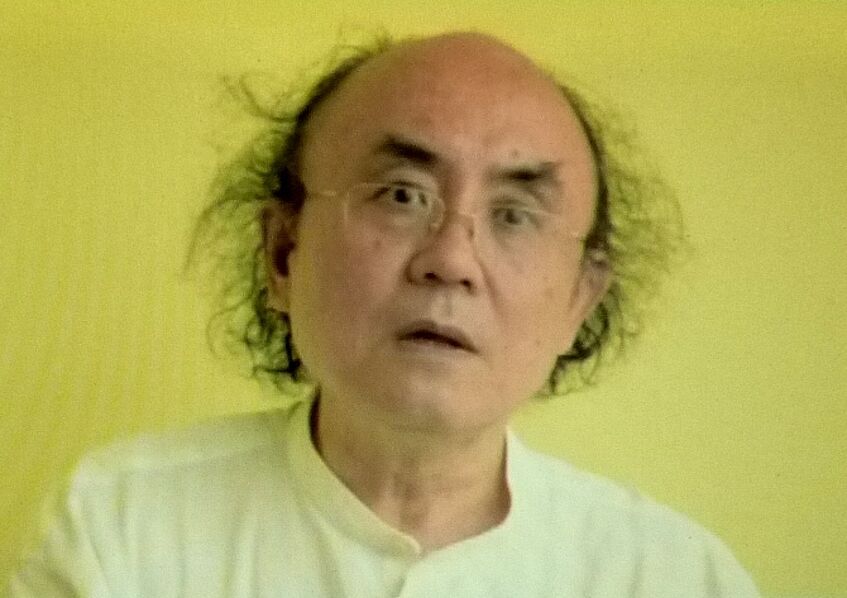
Lei Yi

Lei Yi (2015)

... was born in 1956 in Wuhan (Hubei Province). During the Cultural Revolution in the late sixties, Lei was, like millions of other young people, sent to work in the countryside. After his military service he became a factory worker. In 1978 he was admitted to study history at the Jilin University in the nort-eastern city of Changchun, where he received a bachelor's and a master's degree. In 1985 he obtained a post as a researcher in modern Chinese history at the prestigeous Chinese Academy of Social Sciences. Lei has written numerous books and articles on topics like the history of thought and the role of intellectuals in recent Chinese history. He regularly takes part in international academic meetings and is sought for interviews by Chinese and foreign media.

Traveling to Beijing in 1979, during his university holidays, Lei Yi got in contact with the Democracy Wall Movement, and - using a pseudonym - he contributed several articles for the independent journal "April 5th Forum".

Interview with Lei Yi (on Oct. 31, 2013, at the Zhaolong Hotel in Beijing)

Here you find the Chinese text of the interview.

Interviewer (Helmut Opletal): How did you come into contact with the Chinese Democracy Movement and the independent publications more than 30 years ago?

Lei Yi: Our generation, at least those who were more politically conscious, experienced the Cultural Revolution. It was a time when we also began to care about politics and reflect on China's future. Even in its later stage, just before it was over, some of my friends around started re-thinking it again. The fact that we had been sent to the countryside as “educated youth,” made us ponder.

Later I joined the army, and you know, the army was very strict. There were also a few people dissatisfied with Mao and the Cultural Revolution, and they began to reflect why it could happen like this. Frustration grew. By 1975 or 1976, dissatisfaction with the Cultural Revolution had reached its peak throughout society, even more so with people who liked to read and reflect. Then, in 1978, I thought that the April Fifth Movement of 1976 was actually an indication. I was a soldier in the army in Fujian Province during the April Fifth Movement, and everyone there was very moved by what had happened in January that year.

Interviewer: You all knew that back then?

Lei: Despite strict rules in the military, rumors still circulated. For example, the death of Zhou Enlai in January 1976 was taken as a very symbolic event, and everyone wanted a memorial service being held in the army. But commemorating Zhou Enlai was somehow seen as an expression of dissatisfaction with the Cultural Revolution. The “Central Cultural Revolution Group” [formerly the supreme leading body, now defunct, so probably meaning the radical Maoists in the Party] knew this and stipulated that no memorial service was allowed in any army unit.

Later, when soldiers demanded a meeting be held to commemorate Zhou Enlai, they issued a regulation that it could only be at the company level. We weren’t satisfied and insisted that it should be held at a higher level, at least at battalion level. So that’s what finally happened. The army was under strict control and rigorous ideological surveillance at that time. So everyone had to mourn Zhou Enlai now, although it had actually been an act of opposing the Cultural Revolution. Then a few months later, on April Fifth Movement at Tian’anmen Square happened.

Interviewer: Did everyone understand that mourning Zhou Enlai was an act of opposing the Cultural Revolution?

Lei: I think it was very clear to everyone. But some were just dissatisfied with the reality. They didn't necessarily oppose nor have second thoughts on Mao; they were just dissatisfied with the Cultural Revolution which had lasted for ten years and left chaos. When I was demobilized in the spring of 1978, I should have become a worker. But then, when the college entrance exams were reinstated, I was discharged to take this examination. This was a bit complicated in the army, and one needed a special authorization. So I first requested to be discharged to become a worker in a factory. But in this changing political atmosphere, I was eventually admitted to Jilin University in Northeast China.

Interviewer: What year was that?

Lei: In 1978. Liu Xiaobo [later a famous dissident and Nobel Price laureate] was also at Jilin, he was in the 1977 class. In fact, the classes of '77 and '78 entered university the same year. My family lived in Zhengzhou, Henan Province, and when I went to see them during my winter and summer vacations, I had to change trains in Beijing where I could stay for a few days with relatives. There, I went to the Democracy Wall every day, so I witnessed it from the very beginning. For example, I remember someone I always considered as one of the earliest activists, or a relatively early one, but I forgot what happened to him later. His name was Xia Xunjian. He put up dazibaos on the Democracy Wall, and posted his publications.

Later, I met several human rights activists in Beijing, like Ren Wanding and those from the “April 5th Forum” and the “Spring of Beijing” magazine. During my vacations, I would always stay in Beijing with my relatives for two days, going to Xidan and the Democracy Wall to read all sorts of things posted there. That's how I got to know the journals like “April 5th Forum”, “Spring of Beijing”, “Fertile Soil”, “Today”, and Wei Jingsheng's “Exploration”. These are just the more famous ones. Young people who cared about politics back then, eager to do something; this could be felt from Changchun to Beijing.

Interviewer: What was going through your mind when you read all these things?

Lei: I thought that their ideas were the same as mine. And I thought that's how it should be.

Interviewer: Did you think they were very brave?

Lei: Oh, yes.

Interviewer: Doing all this openly on the street?

Lei: Yes. And their thoughts were the same as mine. But I noticed that although their ideas were the same, they expressed them in different ways. Some were radical, and some were more moderate like the “Spring of Beijing”. Later we heard that the Communist Youth League leadership was behind this journal. Reading it, I had the feeling that Wei Jingsheng's “Exploration” was a bit too radical. Although what he said was correct, the question was, should it be allowed in China at that time? He was directly targeting the Communist Party and Deng Xiaoping, and he thought that Deng and Mao Zedong were just alike.

But in China that time, we were able to exist because there were people inside the Party demanding more reforms. It wasn’t right to point the finger at these people. Despite the fact, that there was a strategy behind. At that time, I also felt that “Spring of Beijing” was too moderate. The “April 5th Forum” was closer to my views and my approach. So after I returned to Jilin University, I wrote several articles for the “April 5th Forum” which they published. They also reported what happened in other places across China, and they introduced journals like the “Path of the People” in Guangzhou, or “Sea Spray” in Qingdao.

Interviewer: There were also some from Shanghai, I suppose?

Lei: There were many all over the country. When I wrote to the “April 5th Forum”, they gave my name to other publications who subsequently contacted me. I was a student at the time, so in the end I only wrote a few articles for the “April 5th Forum”, maybe two or three.

Interviewer: Did you use a pen name?

Lei: Yes, I did. All I remember now is that my first pen name was "Mingzhu" (鸣竹). The character "ming" () is composed of a "mouth" () and a "bird" (), and "zhu" () means bamboo. I remember it was when I began studying history. I was a freshman or sophomore taking classes in world history, and one historian I studied was Jean-Jacques Rousseau, and I remember I wrote an article on him. He advocated for democracy and wanted it to be put into practice, but he believed that only small countries like Switzerland, or city-states, could practice democracy. Large countries, he thought, were simply incapable of realizing it. However, the United States, a large country, eventually implemented democracy.

So the article I wrote tried to prove that large countries could also practice democracy. I remember the title was “It's not that it can't be done, but that it is not done” – large countries weren't incapable, but rather they weren't taking action. Truly implementing democracy required action. I wrote two more articles after that, but I've forgotten the details now.

In university, we had only heard of Rousseau before, but we didn't really know anything about him. During and before the Cultural Revolution, we weren't allowed to read anything. I only knew Rousseau's name because it was mentioned in books I secretly read. When I went to university, the reform and opening up had just begun, and we now got the chance to read Rousseau's books. I studied world history and so I knew Rousseau's ideas. His argument that only small countries could do it, but large countries couldn't, made me write this article, and my first one was published in the “April 5th Forum”.

Interviewer: Do you remember which issue?

Lei: I forgot. It was probably issue fourteen. […] The “April 5th Forum” wanted me to join them, to become a member, but I said I was a rather independent person, I may write articles for you, but I don't want to join any organization.

Later, there were also several publications in Changchun run by young people, but they didn't have much influence. They received my address from “April 5th Forum” and contacted me. I did respond to them. Back then, university students' were quite active everywhere, they also organized elections, and students put up many dazibaos and bulletin boards on the campus. They also held public speeches, and I remember that we used our student union venue several times. They made quite some impression on the university students at the time.

Interviewer: In how many such occasions did you participate?

Lei: We've organized a number of events; the most attention received those about Marx's Asiatic mode of production. Also, in 1980, we paid close attention to the “Solidarity” trade union in Poland. We even organized a lecture series on “Solidarity”.

Interviewer: It seems you were also influenced by what happened in Eastern Europe. How familiar were you with these events?

Lei: We knew quite a bit about them through the “Reference News” (Cankao Xiaoxi) and the “People's Daily”.

Interviewer: So the “Reference News” did publish such information?

Ray: Oh yes, and the “People's Daily” also did. But when I was collecting materials and preparing the lectures on the “Solidarity” union, I noticed a subtle shift in the Chinese official media. You know, during the Cultural Revolution, China had criticized the Soviet Union and Eastern Europe as “revisionists,” calling the Soviet Union a “social imperialist” power. So when in Poland in 1970, workers at the Gdansk shipyard rose up in revolt for the first time, the “People's Daily” fully supported them. The working class had risen up against “revisionism,” they said, and they fully backed it.

During the 1980 “Solidarity”, it was the same; they said again, “The working class rose up against revisionism.” […] But after a few months, this bias had disappeared, and it turned to a relatively objective reporting that called “Solidarity” neither good nor bad. They also didn't say the Polish government was good or bad. But again a few months later, I noticed that they were siding with the Polish government. They were curbing reports in China, and clearly leaned towards the Polish government criticizing “Solidarity” now.

In other words, the Chinese government and the Party had realized that “Solidarity” wasn't actually opposing “revisionism” as they had previously claimed, but they were rather against socialism and communism.

We gave lectures at an Asia Forum and on “Solidarity”. The entire 1980s were intellectually vibrant, especially between the late 70s and early 80s. But already before 1981, I remember, Beijing passed some documents prohibiting dazibaos from being posted on the Xidan Democracy Wall. The Wall was moved to Yuetan Park and simply closed down after a while. Then, in 1981, I clearly recall this moment, they issued the “Document No. 9” about new rules and crackdowns.

Interviewer: Were you still at Jilin University then?

Lei: Yes, I was.

Interviewer: So you were aware of all these circumstances?

Lei: Everyone knew, it was all relayed to the school. Actually, I later found out that our school authorities also knew that I had written articles for the independent journals. So when Document No. 9 was announced, the Party leaders from our department came to see me and said, "We know you have written articles for them."

Interviewer: Although it was under a pseudonym...

Lei: They all knew. They asked me to make a list of the articles I had written, and added that they were aware that I hadn't joined them and I was not one of them.

Interviewer: Did they tell you not to publish anymore?

Lei: That journal had gone, so I could no longer write for them anyway. They told me to obey Document No. 9, and the publication was closed. I had to strictly acknowledge this. Central documents were for the whole of China, they added, and it was finished everywhere in the country.

Interviewer: So they contacted you, although they knew that you weren't a key figure?

Lei: Yes, but that might have been a bit different in every place. If it were in Beijing, I probably wouldn't have much of a problem. But in Changchun, I had also been contacted by some activists, but they knew that I was not an important figure.

Interviewer: So how do you think about this Democracy Movement now? What was the most amazing thing for you?

Lei: First of all, I think, it wasn't very organized. Nobody could control anyone else, right? For example, with Wei Jingsheng's journal, no one said, “Don't publish those articles; they're too radical.” So nobody could control or influence anyone else; it was all written by individuals who could write their own views in the various publications. So, I think, it wasn't organized and therefore there wasn’t any strategic thinking that an organization should have had.

For example, Wei Jingsheng’s, and many other big-character posters, were aimed at the reformists within the Party, implying that everyone was just alike. But initially, Deng Xiaoping was quite tolerant, to some extent even indulgent. And Hu Yaobang and some others also supported the Democracy Wall. Nowadays we all know that Hu Yaobang was quite open-minded.

Interviewer: Did you already know at the time that Hu Yaobang supported the Democracy Wall?

Lei: I didn't know much about it then. I only knew that there was a group of reformists within the Party. And Deng Xiaoping had given a public speech where he said that it was understandable that the masses were angry. Right?

Interviewer: Wasn’t it just a few words he had pronounced?

Lei: Yes, it was just a few words, I knew about them, and I remember they were published in the papers, also in the People's Daily, and they did reflect a sentiment of the whole society then.

At the Democracy Wall, the views on Mao and the Cultural Revolution were very outspoken. Later, more and more people wrote at the Democracy Wall. There were theoretical articles and texts exposing facts. From initially criticizing Mao and the Cultural Revolution, it went on to finally explaining why the Cultural Revolution had happened, and blaming the “system” for it.

But when the texts at the Wall pushed the issue to the systemic reasons, strong disagreement within the Party came up. Before, when Mao and the Cultural Revolution were criticized, Deng and other Party leader supported this, but by taking a step back and focusing on the system, this became a major issue, and sooner or later a conflict was bound to happen.

People like Wei Jingsheng, who lacked strategy, had already  caused this contradiction to erupt earlier. This was an important element. Moreover, looking back now, we were all young at the time, including some writers like Jiang Hong, who ran the “Fertile Soil” magazine – they were all young people. Before and during the Cultural Revolution, I couldn't read many books; I only secretly read some. It wasn't until I got to university that I began studying frantically, but there were many profound theoretical issues that I hadn't really analyzed. In other words, there were so many questions difficult to explain for us.

Interviewer: What kind of questions do you mean?

Lei: For example, regarding state ownership or public ownership. When we talked about a state-owned enterprise, everyone at the time would have said that this was public ownership, and public ownership was defined as ownership by all the people. So how could we argue that it wasn't actually owned by the people?

Many at that time pointed to Yugoslavia and Tito. An article written about Tito had a crucial impact on us then. I forgot the precise name. [It likely refers to Edvard Kardelj's “The Contradictions of Public Ownership in Contemporary Socialist Practice”, that had been translated in China.] I recently wrote a text for the journal “Du Shu” (Reading), analyzing this theory from Yugoslavia. In the 1950s many articles appeared in Yugoslavia opposing Stalinist socialism. Some were translated in China as “internal material,” as well as some articles on Sweden and workers’ welfare and workers’ self-governance in Northern Europe.

Interviewer: Any from Czechoslovakia also?

Lei: From Eastern Europe, it was especially Hungary where we learned from. Some in-depth articles in the independent journals also quoted from them. A small number of people also came into contact with the “alienation theory” [formulated by Karl Marx.] Back then, there was a mimeographed pamphlet, but I don't have it anymore, because everything has been confiscated. It was written by Chen Erjin, and based on theories from Yugoslavia. We didn't have this knowledge at the time and were quite suddenly confronted with Yugoslavia.

The article I recently wrote analyzed China's important reform era in the 1980s. When we recall these thirty years, we cannot ignore the Yugoslav factor, the influence of Yugoslav Communist ideology. […] Reformists at that time, including those in the Party, advocated learning from Yugoslavia, and China sent a large number of economists there.

Interviewer: This was in the 70s?

Lei: Yes, many economists went to visit Yugoslavia around 1979 and 1980. You have to know that Mao, in our theories of the Cultural Revolution, considered Yugoslavia to be the worst, the most revisionist country. The Party Central Committee published the “Nine Commentaries”, and in debates with the Soviet Communist Party during the 1960s, one of the points of contention was whether Yugoslavia can be considered a socialist country or not. The Soviets, specifically Nikita Khrushchev, held that Tito’s Yugoslavia was socialist, while Mao believed it wasn't. Then, suddenly in 1979, China came to the conclusion it needed to learn from Yugoslavia, which also caused a lot of resentment at that time. Nevertheless, from official theorists to ordinary people, everyone was “learning from Yugoslavia” now.

Interviewer: What about the experiences of other Eastern European countries? I remember that in the early 1980s, China invited some representatives of the “Prague Spring” like [reform economist] Ota Šik.

Lei: Yes, Ota Šik and his book “The Third Way” had a huge influence in China when it was translated. It started with Yugoslavia; then it spread to Hungary and Czechoslovakia. I also remember one of the most influential works by János Kornai called “Economics of Shortage”. Many in China still know him […].

Interviewer: After the end of the Democracy Wall Movement and the independent publications, did their ideas continue to have some impact?

Lei: I think some influence was still there, we can see it up until 1989, with people like Chen Ziming.

Interviewer: I mean, was there still some direct influence, were there similar thoughts?

Lei: It was more indirect.

Interviewer: What about Hu Yaobang or Zhao Ziyang, were they influenced?

Lei: That’s hard to say, but the Democracy Wall has greatly inspired a certain group of university students and their thinking in their search for new ways. They saw the need for reforms, a reform of the economic system. From Eastern Europe, Ota Šik’s ideas gradually developed up to the 1990s or even now. We acknowledged Friedrich August von Hayek’s Austrian School of Economics. All these were unprecedented developments.

At the beginning, everyone still believed in socialism, and that we had to uphold socialism. But China, Stalin, Mao, they weren’t truly socialist. Yugoslavia was probably, the Prague Spring was probably, the quiet reforms in Hungary were perhaps. We hoped to follow their path, so at that time, the most influential thing was translation and publication, and also, besides the current situation, reflections on history.

At that time, no “Thaw” [like Knrushchov’s era in the USSR] had yet occurred in China, so we couldn't talk much about it. First, some books about the Soviet Union could be published “internally,” for example, on Nikolai Bukharin [a Soviet politician and Marxist theorist.] So many began to reflect on the Stalinist model, and many saw China as similar to Stalin’s model, knowing that he had fabricated all these injustices.

At that time, many books about Bukharin and the Soviet Union were translated. There were internal books criticizing Stalin […] like “Varga's Last Words” [Yevgeny Varga, Soviet economist and author of "The Russian Path to Socialism and Its Outcomes".] So these were the sources of information available and the knowledge we had been exposed to from childhood that could enlighten us. It also included Eurocommunism, represented by [Spanish Communist] Santiago Carrillo.

So Eastern European communism had a significant impact on our generation because it used Marxism, which easily connected with the knowledge we had grown up with. Eastern European communism and Eurocommunism were a critique of the Stalinist model and Stalin himself. Even nowadays, in the 21st century, many people use Western Marxism to argue for Marxism and the authoritarian rule of the Communist Party. Back then, the same theories were used for criticism, and the same thing had different effects.

Interviewer: Wasn’t the struggle between conservatives and reformers quite intense in the 1980s?

Lei: In fact, it was an severe fight at the time. It mainly happened within the Communist Party, while ordinary people and young students tended to demand and support reform. Even young people who hadn't gone to university thought that reform was good and that their lives would improve with it.

For example, during the anti-spiritual pollution campaign it was forbidden to wear jeans, because that had been an absolute no-go during the Cultural Revolution. Only after the reform and opening up had started, they could obtain and wear them through the black market. But during the spiritual pollution campaign, they were forbidden again.

People knew that Hu Yaobang supported reform, and he stopped the “spiritual pollution” campaign. You can find it in the archives, although I don’t remember it exactly. The China Youth Daily published a series of articles, where he didn't refute the campaign ideologically, but rather from a lifestyle perspective. He said, “What's wrong with young people wearing these jeans? Why are you linking this to politics and capitalism?” He added, "These are what American working people wear; they're for the proletariat.”

Another example at the time was that other trousers like the bell-bottoms, also imported from abroad, were forbidden as well. But then Hu Yaobang also pointed out, and the China Youth Daily, run by the Youth League, published an article that said that China had those historic murals in Dunhuang, Gansu, depicting flying apsaras or heavenly maidens. Their bell-bottoms were a traditional national garment, certainly not some decadent bourgeois ideology as the conservatives said. So why shouldn’t they be worn? It was things like that made that common people who weren't interested in politics, also supported reform.

And again, talking about music, there was a singer called Li Guyi, who was praising the Communist Party, but she sang in a very soft tone, that was not permitted at the time, even with a microphone. Many people thought this wasn’t justified, and they appreciated listening to softer music. So, the entire atmosphere in the 1980s was one of hope for more reform.

Interviewer: In what year did you come to Beijing?

Lei: In Changchun I studied history at Jilin University from 1978 to 1982 as an undergraduate, and from 1982 to 1985 as a graduate student. Then I went to Beijing, but I had already met activists like Li Shengping, Chen Ziming and some others during my graduate studies.

Interviewer: So another of my question touches on the historical perspective. How should we approach that period? What do Chinese historians think about it today? And is it possible to conduct research in this area?

Lei: Now, for example, you can't even see past publications anymore, so it's impossible to do serious research. Only a few individuals can do research, because of their connections. Personally, I'm also collecting materials and would like to do some research in this field, but it's very difficult. Studying the 1980s, we are still in the stage of putting the facts together. The article I have written was part of this research. Of course, because I couldn't say things openly, I mainly pointed out that the Party theorists at that time believed in Yugoslavia's system of national ownership. That was my perspective, and that we shouldn’t forget this fact in our history of reforms and that I think it played a crucial role in the ideological enlightenment of young people.

Those who are still very active now, like Chen Ziming, Li Shengping, and Xu Youyu, all participated somehow in these debates and activities outside the official structures, including myself. There was also someone at the University of Vienna who didn't participate. His name was Zhu Jiaming. He became close to Zhao Ziyang and others. […] Their group had a debate whether they should get involved in our activities, but they thought that since they had already entered the “system,” it wouldn't be useful. So they didn't participate. But their ideas were basically the same, some more radical, some more moderate.

I think, this really was a Chinese enlightenment movement from the grassroots. Look at the Democracy Wall, where young people were even bolder in their proposals. Yes, this was a real enlightenment movement for China. It was some young people, often lacking sufficient knowledge, who undertook this task. […]

Interviewer: Do young people today, and more specifically students of history or modern history, know about all these developments?

Lei: I am not sure. The system is still very powerful. Today, many people don't even know much about something as big as the June Fourth rebellion of 1989, let alone the Democracy Wall, which had existed for quite some time. The vast majority of people still don't know. Even in the late 80s, many students didn't know that such events had happened in the early 80s. So our education system is very closed off.

Interviewer: After the Cultural Revolution, how have history books mentioned all these events?

Lei: They don't mention them at all, they just don't mention them.

Interviewer: So they just talk about the Third Plenum of the Central Committee in 1978, that initiated reform and opening up, and that's it?

Ray: That's it. Then they will continue talking about 1992.

Interviewer: Isn’t there any internal research either, things that are possibly not made public?

Lei: Very little, because it's quite difficult to collect relevant information now. In this regard, I know that Chen Ziming has the most complete data in China. And one has to say that the quality of publications at that time also varied. In my view, “April 5th Forum” and “Spring of Beijing” were of a higher standard.