
Mao Lizi (Zhang Zhunli)

Mao Lizi (2013 in Beijing)
Mao Lizi (Zhang Zhunli)
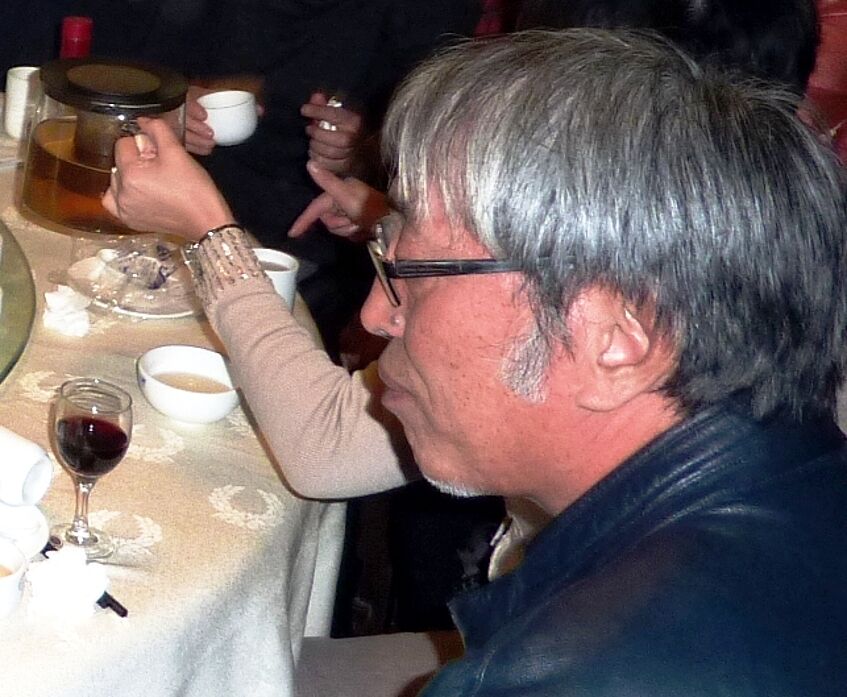
... was born in 1950. During the Cultural Revolution he joined a theater unit of the People's Liberation Army where he worked as a set designer. In 1979, he participated - secretly at first, under his pseudonym "Mao Lizi" - at the avant-garde art exhibition of the "Stars" group. When his superiors found out, he was told to leave his army job in order to avoid a military investigation and trial.
Mao Lizi became an independent artist, in 1981 he was awarded a youth art prize in China. Like other avantgarde artists in the mid-eighties, Mao Lize left China to spend a few years in France and in the United States. In 1989, he participated in the anniversary exhibitions "The Stars - Ten Years" in Hong Kong and Taiwan and a number of other international exhibition. Later he decided to return to China, Mao Lizi now works in his studio in the "798" cultural district of Beijing.
Interview with Mao Lizi (on October 27, 2013 in his studio in Beijing's "798" cultural district)
Here you find the Chinese text of the interview.
Interviewer (Helmut Opletal) : Looking back at the time of the beginning of the Chinese avant-garde art, what do you think about it now?
Mao Lizi: I think at that time everyone was trying to break free from the Soviet-style control of the art world and wanted to develop his own style. However, when these people came together, they did not share a unified artistic style, but everyone just wanted to practice a unique or free kind of art, and the results were completely different. I think at the first Stars Art Exhibition, my art work was still close to the past, without any major breakthroughs. But by the second Stars Exhibition, I had taken a big step forward personally, and I think that was quite innovative. In the first exhibition I had just showed a sketch and a still life, not much different from the art that had been popular in China in the past.
Interviewer: When did you start painting? Were you self-taught or did you learn from somewhere?
Mao: It looks like I was self-taught, but in reality, I received a fairly formal training. I loved drawing and painting since I was little, painting a lot when I was twelve or thirteen. When I was fourteen or fifteen, I practiced at the Xicheng District “Children's Home” and the Beijing Children's Palace. I don't know if you understand those institutions, but they are government-funded establishments that provide art and sports training for kids. The Beijing Children's Palace is located in Jingshan Park, and for young people, it is the best place in Beijing to learn painting.
Interviewer: Was this in the early 70s?
Mao: In the 1960s, before the Cultural Revolution. We started learning sketching and drawing there, similar to the training at an art academy. Two years later, around 1965, I had a private teacher for oil painting. He was keen to teach me, and I was willing to learn from him. I had a classmate then who also studied painting, and his brother was learning oil painting together with a good friend and classmate. You have heard of a group called “No Name Painting Association”. These two were classmates of Zhao Wenliang and Yang Yushu. They didn't achieve the same fame as Zhao Wenliang, although they painted just as well.
Then in 1965, my teacher was arrested and sent to Inner Mongolia in Northeast China, and he never came back. He was still alive, but had disappeared from the art world. In 1965, he had taken me to paint nature scenes and landscapes. Less than a year later, he was arrested.
I continued painting during the Cultural Revolution when I was sent to the countryside to Inner Mongolia and Shaanxi, initially to a agricultural project run by the military, then to a so-called “cadre school” in Shaanxi and later to another one in Hubei. From there I was sent to a factory in the mountains, before I passed the entrance exam for the cultural troupe of the army. As I was very good at landscape painting, this helped to pass this exam.
They military had many song and dance units, and they needed stage designers, and more specifically people very good at landscape painting. So I was lucky. Being able to pass the exam, I could move from a remote mountain village to a military troupe in Beijing, and at the same time, join the army. Joining the army was very fashionable then, and living conditions were quite good there. And I was happy to return to Beijing. That was in 1973.
In 1976, I joined the Air Force Song and Dance Ensemble as a stage art designer. That same year, the Tangshan earthquake happened. I was serving in the army at the time, and my unit sent me to Tangshan just a few days after it had happened, and I stayed there for about a month.
When I returned, I fell ill with hepatitis, which lingered for several years. From 1976 to 1979, while I was recuperating, A-Cheng [“Stars” artist Zhong Acheng] came to see me and asked if I would like to participate in an exhibition. I said I was sick and couldn't really take part. But he replied it didn't matter, and I should just bring him one of my paintings. So I gave him one. During those three years, I hadn’t painted much, just a few still lives, sketches, nothing special. So I handed one painting to A-Cheng, who then submitted it to the first Stars Art Exhibition.
Interviewer: You didn't go by yourself?
Mao: No, I didn't. And I also didn't participate in the demonstrations, I didn't go anywhere. [Laughs]
Interviewer: But you were aware of all of this back then?
Mao: I didn't really know. I only found out later, after their street protest. The following year, when I was feeling a bit better, I produced three new paintings. The “Cigarette Butt” you just saw is one of them, and the other two are in the same style. That painting seemed to attract quite some attention at the exhibition, so the effect was rather positive.
Just at that time, there was an exhibition of paintings by a famous French artist, Jean Hélion, downstairs. The “Centre Pompidou” held this exhibition for him at the Beijing Fine Arts Gallery. The modern art director of the Centre Pompidou was in Beijing at the time, and he also went to see the second Stars Art Exhibition.
When he saw my three paintings, he tried to find me and talk to me. I wasn't there at the time, but he told the others that he was usually downstairs and I should go to see him if I was interested. When I came back, they told me. I'm not very good at talking by myself, so I asked Yang Yiping to accompany me when I went to see him.
The director from the Centre Pompidou criticized a lot of our exhibition, saying it wasn't avant-garde enough, most of the paintings were meaningless, lacking innovation and thought. We felt unhappy and argued with him. He said, “Of course, there are some good things.” So I asked, “Then which ones do you like?2 He answered, “Yours for example.” That was why he wanted to talk to me. What he meant was that most of the others were not just as good. But mine was somewhat interesting, so he wanted to discuss it with me. After all, that painting did receive some attention at this exhibition.
When he had left, a commentator from the Swiss paper “Neue Zürcher Zeitung” came to see me. He's still alive [He had actually died in 2011.] He was a quite prominent journalist, but not stationed in China. His name was Ernst Kux, and he had come to Beijing to interview Zhao Ziyang. When he saw this painting, he told people that he would come back on the last day, the closing day of our exhibition, and he asked that I should wait for him then as I myself was absent that day. But I happened to be there on the last day when he came. He inquired if I was willing to sell the “Cigarette Butt”, if he could buy it. I agreed. So he asked me, "How much do you want?"
By then, none of us had ever sold paintings. Probably no one in all of China had ever sold an oil painting. Maybe some people had sold traditional Chinese paintings. So this was the first time, I think it was in 1980. A few of us discussed how much money we should ask for. After quite some deliberation, we gritted our teeth and said five hundred Yuan, which we thought was a lot.
When were to tell him, his translator, a Chinese who was familiar with the situation abroad, told us, he knew that foreigners were used to haggling. So if we really wanted five hundred dollars, we should ask for more first. We answered no problem, thinking that we had already asked for a high price and weren't afraid of him bargaining. We said five hundred, he proposed three hundred. We answered okay, four hundred. He said he agreed, four hundred Yuan in “foreign exchange certificates” [a convertible parallel currency for foreigners,] but he wanted to pay in US dollars. At the time, the exchange rate was one to two, so it was two hundred US dollars. Everyone was happy; after a meal, those two hundred US dollars were exchanged for four hundred Yuan in foreign exchange certificates.
My health was quite bad then, and I wasn’t fit enough to ride a bicycle. I had to travel long ways, so I kept thinking about buying a small motorcycle, which cost exactly 400 Yuan. 400 Yuan in “foreign exchange certificates,” as you know, were more than 400 regular Renminbi. I did see many beautiful motorbikes on the street, and people said they cost 550 Renminbi, but were difficult to buy. They were produced by factories under the Ministry of Ordnance Industry. I then knew a former colleague of my father who happened to be the vice minister of that ministry. So I went to see him and asked for help. He wrote a note for me that allowed me to buy this motorcycle.
My health was still poor, so riding the motorbike made me happy. I rode around everywhere, and felt relieved. My mood had also improved, unlike before when I was always lying in bed at home recovering from my illness. It hadn't gotten much better for three years, so I stopped caring about it. I did what I was supposed to do. I went out and had fun. A year later, everything was fine.
I continued painting in this style, but then I ran into some trouble. I was the only one among all these artists who was in the military. I was still an active-duty soldier, and this became very troublesome. I held the lowest officer rank in the army. Normally, I would be promoted one rank every year or two. But from participating in the Stars Art Exhibition in 1979 till leaving the army in 1988, for almost ten years, and fifteen years from when I was enlisted in 1973, I hadn’t been promoted one single rank. [Laughs]
By 1988, the problem had become even more serious. The State Security Bureau and the Police kept inquiring at our unit, and later the cultural troupe reported this to higher authorities, they were told that I had frequent contacts with foreigners. So they wanted to talk to me. I asked, what law have I broken? They said I hadn't broken any laws, but seriously violated military discipline. That’s why the higher-ups were investigating and wanted to discharge me from the military. They said “at least discharge,” meaning it could be even more serious.
I asked what a more serious outcome could be. Maybe a military court, they said. But then they added, “We will show you a smart way out.” I asked, “What way out?” They responded, “Write a resignation letter, a transfer application. Request yourself to leave. We'll approve it immediately. If the superiors still investigate what happened, whether you were punished, we will just tell that you've already left.” So I immediately wrote a transfer application and left the army. But then I didn't know where to go.
Interviewer: Back in 1979 and 1980, no one in the military opposed what you were doing?
Mao: Of course they didn’t agree. But they didn't know, because I didn't tell them. But later they found out.
Interviewer: Is "Mao Lizi" your real name or a pseudonym?
Mao: It's a pseudonym, not my real name. Why did I choose Mao Lizi? I used it for this exhibition. I was my nickname from elementary school, not the name on my registration papers.
Interviewer: So they didn't know that it was you before?
Mao: I thought first they wouldn't know, but they had found out very quickly. Why did I write that transfer report so readily? Because I also knew that they knew. In 1987, I had already signed a contract with an American gallery for a solo exhibition in 1989. So I wanted to travel to the United States. And I considered that if I didn't leave the military, I wouldn't be able to go. So when they asked me to write my resignation, I did, and I could leave. In 1989, in line with that contract, I traveled to New York, and in January, I had my solo exhibition there.
Afterwards, I could have stayed in the United States. But then, the Tian’anmen Square protests began. In May, there were many reports on television. At that time, I often watched TV together with Liu Xiaobo [Human rights activist. He went back to China, where he was sentenced to eleven years in prison, before receiving the Nobel Peace Prize In 2010.]
I thought it was time for me to go back home. Although many people advised me not to leave, I still returned to China after June 4th, because I had never participated in any political activities; I was just concerned. After June 4th, I stayed in Beijing for a year. I wanted to travel abroad, but I never had the intention not to come back.
By 1990, I had contact with many people at different foreign embassies, and they all treated me very well. When I expressed my desire to travel, five countries offered me visas: the US, Italy, France, the United Kingdom. At that time it was difficult for Chinese citizens to obtain visas, and there were long queues outside the US embassy, even at night. In the end, it was France who not only gave me a visa but also provided financial assistance, so I went to France.
The passport itself was easy, but there was another problem. I already had a passport before, but I still had the get an exit permit. But the police were giving me trouble, and I already thought that I wouldn't get my exit card. But unexpectedly, when I went to obtain the permit after everything else had been done, they actually gave it to me.
Normally the exit cards would be handed out right away, but when I got there, the officer looked at my passport, went into an inner room, and didn't come out for quite a while. I thought I was doomed and wouldn't be able to leave. But when he came out, he didn't say a word and just handed me the permit. So, I was lucky. They had probably discussed it inside for a long time.
Interviewer: Did they know who you were?
Mao: Oh yes, definitely. So I went to France. Originally, I was going to study at the Paris Academy of Fine Arts, so I prepared all the materials and had made all the arrangements. But as soon as I walked in, the dean said, “I have good news for you. From today on, you will not be a student at our school, but a visiting professor.” I asked, “Then what should I do?” He said, “You don't speak French, so you don't have to teach. Of course, if you want to teach, you can find a translator. But you don't have to teach. We'll provide you with a studio for a year, plus 8000 Francs [about 1300 USD] per month for living.” I said, “And then what?” He said, “Nothing else!” [Laughs] He added, “After a year, we can organize an exhibition for you.”
So I stayed in Paris. After that year, all my friends told me that I had made a mistake by returning to China from the US, and I shouldn't leave Paris now. At least I should get a residency status first. So I stayed in France. I had arrived in 1990, and in 1993 they gave me a permanent studio, where I could live for the rest of my life. That studio is still in Paris now.
Interviewer: You said you've never participated in any political activities. But you must have realized that the “Stars” artists were quite close to the Democracy Movement. How did you think about this at that time? Did you believe they shouldn't be involved in politics?
Mao: No, no, no, even now I hope that China will move towards democracy where the citizens will have the say. I did sympathize with them, but personally I haven't participated in anything because I've never liked getting involved in politics. I still do have my own views and opinions.
Interviewer: Were you worried that you could also be affected negatively at that time?
Mao: Yes, I thought it would have a huge impact for me, didn't I just tell you? But at the same time I thought it didn’t matter.
Interviewer: Later you didn't participate in political activities either?
Mao: No, no. I'm a painter, my main job is painting. I definitely have my own opinions and views, but I generally don't participate in actions.
Interviewer: Did you never consider that your paintings could express a political content?
Mao: No. My paintings are mostly abstract. There was a little bit at the beginning when I was with the Stars, but not anymore. Art shouldn’t be so direct, but still everyone should be able to understand it, as there's a lot of meaning beyond the images. These past two years have been entirely concerned with form.
Interviewer: Do young painters in China today understand what happened during that time?
Mao: Generally they are not too interested. Whether they understand it or not depends on their age. If they are older and can remember the Democracy Movement of the early 80s, they will understand. If they are too young to have memories of those events, then there's nothing that can be done.
